

- +91 - 95 60 222 333

Accelerated Weathering Testing

Accelerated Weathering Testing Services
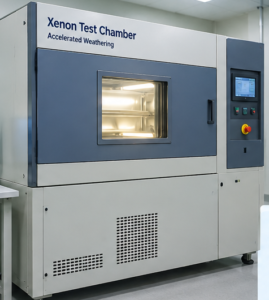
Accelerated weathering testing evaluates how materials and products withstand prolonged exposure to sunlight, ultraviolet radiation, heat, humidity, moisture, and water spray. It is widely used to assess colour stability, surface degradation, mechanical-property retention, cracking, chalking, gloss loss, yellowing, fading, and other forms of environmental deterioration.
Our laboratory provides xenon arc accelerated weathering testing using a programmable Xenon Test Chamber equipped with interchangeable optical filter configurations, including Daylight Filter, Window Glass Filter, and Extended UV Filter.
Xenon arc testing is suitable for plastics, polymers, paints, coatings, textiles, automotive components, building materials, roofing products, adhesives, sealants, packaging materials, leather, outdoor products, and consumer goods.
What Is Xenon Arc Weathering Testing?
A xenon arc lamp produces radiation that closely simulates the spectral distribution of natural sunlight. The test chamber controls exposure conditions such as:
- Xenon arc irradiance
- Spectral distribution
- Black Standard Temperature (BST)
- Black Panel Temperature (BPT)
- Chamber air temperature
- Relative humidity
- Water spray
- Condensation/moisture cycles
- Light/dark cycles
- Exposure duration
The specimen is exposed for a specified period and subsequently evaluated for physical, optical, chemical, or mechanical changes.
The test conditions are selected according to the applicable international standard, product specification, customer requirement, or research objective.
Xenon Test Chamber Filter Configurations
Daylight Filter
The Daylight Filter is intended to reproduce a spectral distribution representative of natural outdoor sunlight.
It is commonly used for:
- Outdoor plastics
- Automotive exterior components
- Paints and coatings
- Roofing materials
- Construction products
- Outdoor furniture
- Polymer products
- Agricultural films
- Signage
- Exterior decorative materials
Window Glass Filter
The Window Glass Filter simulates sunlight passing through window glazing. Because window glass reduces transmission of shorter-wavelength UV radiation, this configuration is particularly relevant for products used indoors or inside vehicles.
Applications include:
- Automotive interiors
- Indoor plastics
- Furniture
- Flooring
- Textiles
- Decorative materials
- Interior coatings
- Consumer products
- Products displayed near windows
Extended UV Filter
The Extended UV Filter permits increased short-wavelength UV exposure compared with conventional daylight or window-glass configurations.
It can be useful for specific accelerated durability studies, UV-sensitive materials, research and development, and applications where the applicable test method specifies an extended UV spectrum.
The filter configuration should always be selected according to the applicable test standard because changing the spectral distribution can change the degradation mechanism.
Major Xenon Arc Weathering Test Standards
Different industries use different xenon exposure standards. The applicable standard depends on the material, product, intended environment, and performance characteristic being evaluated.
1. ISO 4892-2
ISO 4892-2 – Plastics — Methods of exposure to laboratory light sources — Part 2: Xenon-arc lamps
This is one of the principal international standards for xenon arc exposure of plastics.
It covers laboratory exposure using xenon arc light sources and provides guidance on exposure conditions, irradiance, temperature, moisture, filters, and exposure cycles.
Typical applications include:
- Plastics
- Polymer compounds
- Plastic components
- Automotive plastics
- Outdoor products
- Consumer products
2. ASTM G155
ASTM G155 – Standard Practice for Operating Xenon Arc Light Apparatus for Exposure of Nonmetallic Materials
ASTM G155 is widely used internationally for accelerated exposure of non-metallic materials.
It provides procedures for operating xenon arc apparatus and controlling parameters such as irradiance, temperature, humidity, and moisture.
Applications include:
- Plastics
- Coatings
- Paints
- Textiles
- Sealants
- Adhesives
- Roofing materials
- Building materials
- Automotive materials
3. ISO 105-B02
ISO 105-B02 – Textiles — Tests for colour fastness — Colour fastness to artificial light: Xenon arc fading lamp test
This standard is specifically important for textile and dyed-material applications.
It evaluates resistance of textile colours to artificial light exposure using a xenon arc source.
Applications include:
- Garments
- Upholstery
- Automotive textiles
- Curtains
- Carpets
- Technical textiles
- Outdoor fabrics
Results may be assessed using specified reference materials and colour-change evaluation procedures.
4. AATCC TM16.3
AATCC TM16.3 – Colorfastness to Light: Xenon-Arc
This textile test method evaluates the resistance of textile materials to colour change caused by exposure to xenon arc light.
It is commonly used by textile manufacturers, apparel companies, retailers, and laboratories for evaluating lightfastness.
5. SAE J2412
SAE J2412 – Accelerated Exposure of Automotive Interior Trim Components Using a Controlled Irradiance Xenon-Arc Apparatus
This standard is used for accelerated exposure testing of automotive interior materials.
Typical materials include:
- Dashboard materials
- Interior plastics
- Trim components
- Fabrics
- Vinyl
- Leather
- Coated components
- Polymer materials
The test evaluates resistance to light and environmental exposure under controlled laboratory conditions.
6. SAE J2527
SAE J2527 – Accelerated Exposure of Automotive Exterior Materials Using a Controlled Irradiance Xenon-Arc Apparatus
SAE J2527 is used for automotive exterior materials and components.
Applications include:
- Exterior plastics
- Automotive coatings
- Painted components
- Polymer parts
- Exterior trim
- Body materials
- Decorative surfaces
It is particularly useful for evaluating colour and appearance retention under accelerated environmental exposure.
7. ISO 16474-2
ISO 16474-2 – Paints and varnishes — Methods of exposure to laboratory light sources — Part 2: Xenon-arc lamps
This standard is relevant to paints, varnishes, and coating systems.
Testing can be used to evaluate:
- Colour change
- Gloss retention
- Cracking
- Chalking
- Blistering
- Peeling
- General coating degradation
8. ASTM D2565
ASTM D2565 – Standard Practice for Xenon-Arc Exposure of Plastics Intended for Outdoor Applications
This standard is applicable to plastics intended for outdoor use.
It can be used for evaluating the effects of xenon arc exposure on plastic materials and determining changes in appearance and physical properties.
9. ASTM D6695
ASTM D6695 – Standard Practice for Xenon-Arc Exposures of Plastics
This practice provides procedures for xenon arc exposure of plastic materials.
It can be used for comparative evaluation of formulations, materials, pigments, additives, and finished plastic products.
10. ASTM D7869
ASTM D7869 – Standard Practice for Xenon Arc Exposure Test with Enhanced Light and Water Exposure for Transportation Coatings and Materials
This standard is particularly relevant to transportation-related materials and coatings.
It provides controlled accelerated exposure conditions designed for evaluating material durability under light and moisture.
11. ISO 105-B06
ISO 105-B06 – Textiles — Colour fastness and ageing to artificial light at high temperatures
This standard is relevant to textile materials where lightfastness and ageing performance need to be evaluated under controlled laboratory exposure.
12. ISO 4892 Series
The ISO 4892 family covers laboratory exposure of plastics to artificial light sources.
Relevant parts include:
| Standard | Application |
|---|---|
| ISO 4892-1 | General guidance for laboratory light-source exposure |
| ISO 4892-2 | Xenon-arc exposure |
| ISO 4892-3 | Fluorescent UV lamps |
| ISO 4892-4 | Open-flame carbon-arc lamps |
For xenon chamber testing, ISO 4892-2 is the principal part.
Other Product-Specific Xenon Weathering Standards
Depending on the product, additional standards or specifications may be applicable.
Plastics & Polymer Materials
- ISO 4892-2
- ASTM G155
- ASTM D2565
- ASTM D6695
Paints & Coatings
- ISO 16474-2
- ASTM G155
- ASTM D4587 where applicable to fluorescent UV exposure
- Customer/OEM-specific coating specifications
Textiles
- ISO 105-B02
- ISO 105-B06
- AATCC TM16.3
Automotive
- SAE J2412 – Automotive interior materials
- SAE J2527 – Automotive exterior materials
- Automotive OEM-specific specifications
Building & Construction Materials
- ASTM G155
- ISO 4892-2 where applicable to polymeric materials
- Product-specific ASTM/ISO specifications
Roofing & Polymer Membranes
- ASTM G155
- Applicable ASTM/ISO roofing and membrane product standards
- Manufacturer/OEM specifications
The exact standard should be confirmed from the product specification because not every material should be tested using the same exposure cycle.
Typical Xenon Weathering Test Parameters
Depending on the selected standard, a test program may specify:
| Parameter | Typical Consideration |
|---|---|
| Light source | Xenon arc |
| Optical filter | Daylight / Window Glass / Extended UV |
| Irradiance | Standard-specific |
| Irradiance wavelength | Standard-specific |
| Black Standard Temperature | Standard-specific |
| Black Panel Temperature | Standard-specific |
| Chamber air temperature | Standard-specific |
| Relative humidity | Standard-specific |
| Water spray | Yes/No depending on method |
| Light cycle | Continuous or cyclic |
| Dark cycle | Where specified |
| Exposure duration | Hours/cycles |
| Specimen orientation | Standard-specific |
Important: The values should not be selected simply based on a generic xenon chamber setting. The exact irradiance, temperature, humidity, filter and water cycle should be taken from the applicable test method.
Evaluation After Xenon Exposure
Following exposure, specimens can be examined for changes such as:
- Colour change (ΔE)
- Colour fastness
- Gloss retention
- Yellowing
- Fading
- Chalk resistance
- Cracking
- Crazing
- Blistering
- Peeling
- Surface deterioration
- Embrittlement
- Tensile strength retention
- Elongation retention
- Impact resistance
- Adhesion
- Hardness
- Appearance
- Mass change
Instrumental measurements can be performed before and after exposure to quantify degradation.
Why Choose Xenon Arc Weathering Testing?
Xenon arc testing provides a controlled and repeatable laboratory method for studying the effects of sunlight and environmental exposure.
It helps manufacturers to:
- Compare material formulations
- Select UV-resistant materials
- Validate product durability
- Investigate field failures
- Improve formulations
- Conduct R&D studies
- Support product qualification
- Establish quality-control requirements
- Compare suppliers and raw materials
- Assess colour and appearance retention
Accelerated weathering results should not automatically be converted into a specific number of outdoor service years. Actual outdoor durability depends on material chemistry, geographical location, climate, exposure orientation, product design, and degradation mechanisms.
Get Your Product Tested
Our Xenon Arc Accelerated Weathering Testing facility can support testing according to applicable ISO, ASTM, SAE, AATCC and customer/OEM specifications.
Testing can be performed using appropriate Daylight, Window Glass, or Extended UV Filter configurations, together with controlled irradiance, temperature, humidity and water exposure.
Our technical team can review the requirement and recommend the appropriate xenon arc exposure method, filter configuration, test cycle, exposure duration, and evaluation parameters.
Want to speak to our Customer Care Executive?
Just Submit Your Contact Details and We’ll be get in Touch With You Shortly.